The 2:58 problem
For three years, Marisa Whitlock woke at the same minute every night. She tried melatonin, magnesium, a sleep clinic and a prescription she never filled. What finally moved the needle wasn’t anything she swallowed.

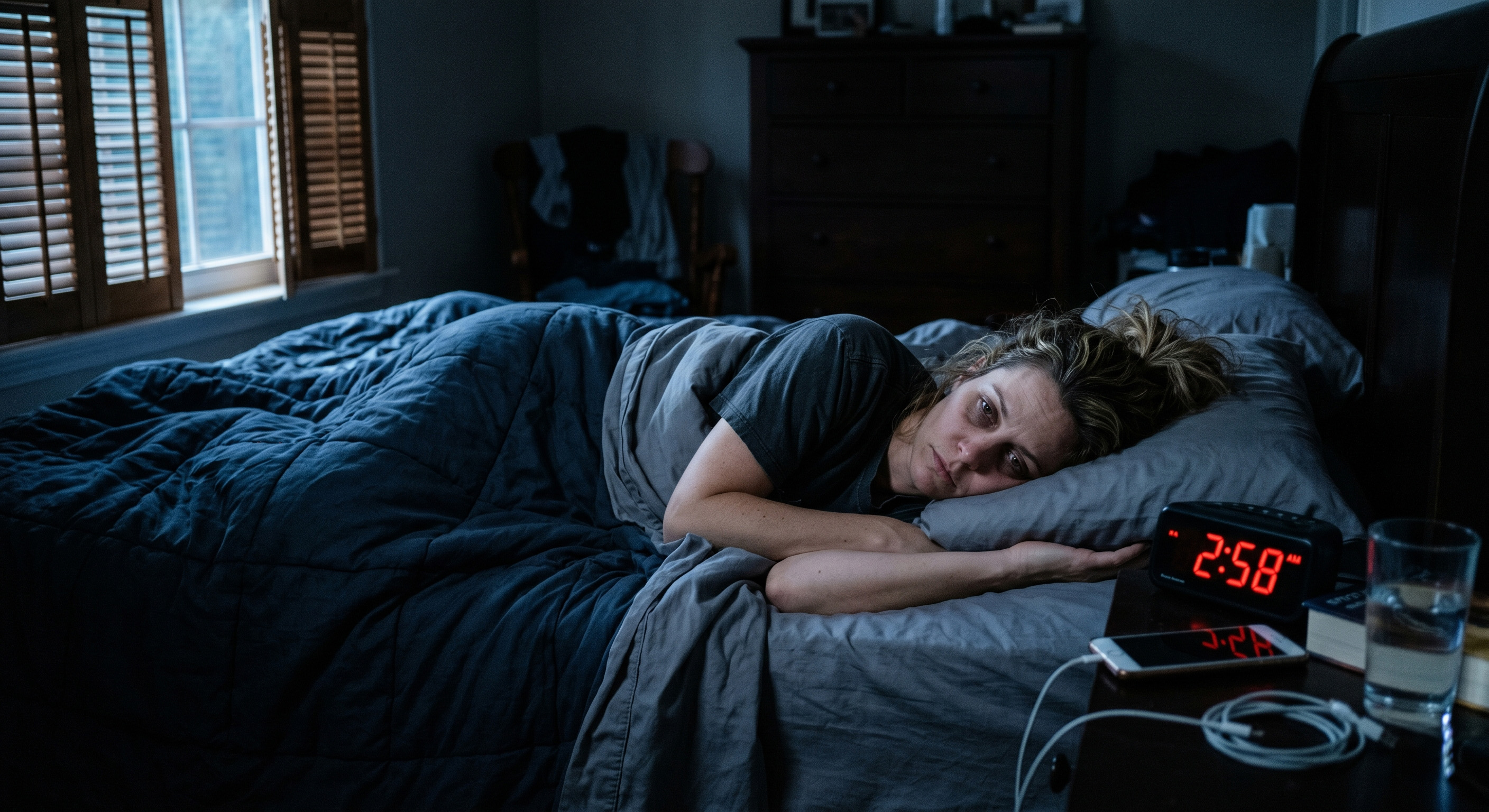
The clock said 2:58. It nearly always said 2:58.
Marisa Whitlock, 44, an office administrator at a middle school in Elkhart, Indiana, had stopped being surprised by it. She would surface out of a thin, unconvincing sleep, and before she opened her eyes she would already be doing the arithmetic she did every night: if I fall asleep in the next twenty minutes, I get three hours and forty-one minutes.
She almost never fell asleep in the next twenty minutes.
“People say ‘I’m a bad sleeper’ and they mean they were up late once,” she says. “I mean I watched the ceiling for three years.”
How it started
It began, as these things often do, with a reason. In the autumn of 2022 her mother had a stroke, and for eleven months the guest room at the end of the hall was a hospital room. Whitlock slept, when she slept, with the door open and one ear working — listening for the walker, for a cough, for the particular sound of someone trying not to wake anybody.
Her mother eventually moved to a care facility twenty minutes away, and got better, and the house went quiet again. The listening did not stop. Her body had learned a job, and nobody told it the job was over.
“The crisis ended. My nervous system just never got the memo.”
This is, sleep specialists say, an ordinary way for chronic insomnia to begin. The trigger and the condition are two different things. Something legitimate breaks your sleep — grief, a newborn, a stretch of night shifts, a season of stress at work — and then the trigger resolves and the sleeplessness stays behind, self-sustaining, fed now by the anxiety of not sleeping.
Roughly one in three American adults reports routinely getting less sleep than they need, and by commonly cited estimates somewhere between ten and fifteen percent of adults meet the criteria for chronic insomnia — difficulty falling or staying asleep at least three nights a week, for three months or longer, with daytime consequences. Whitlock cleared that bar the way a truck clears a speed bump.
The part nobody photographs
The nights were bad. The days were worse, and harder to explain.
She started losing the middles of sentences. She read the same email four times and retained nothing. She put the milk in the pantry, twice in one week, and found it warm. In February she snapped at her son, Theo, 16, over a bowl left in the sink, and heard her own voice come out with an edge she didn’t recognize.
Then came the morning on U.S. 20 — driving Theo to a 7 a.m. practice, coffee in the holder, and a stretch of about four seconds she genuinely cannot account for. She remembers a mailbox. She remembers the rumble strip. She remembers her son saying “Mom.”
“That was the day it stopped being an inconvenience,” she says. “That was the day it became a problem I had to actually solve.”
The spreadsheet
Whitlock is an administrator by trade, so she did what administrators do. She opened a spreadsheet. One column for what she tried, one for how long, one for what happened.
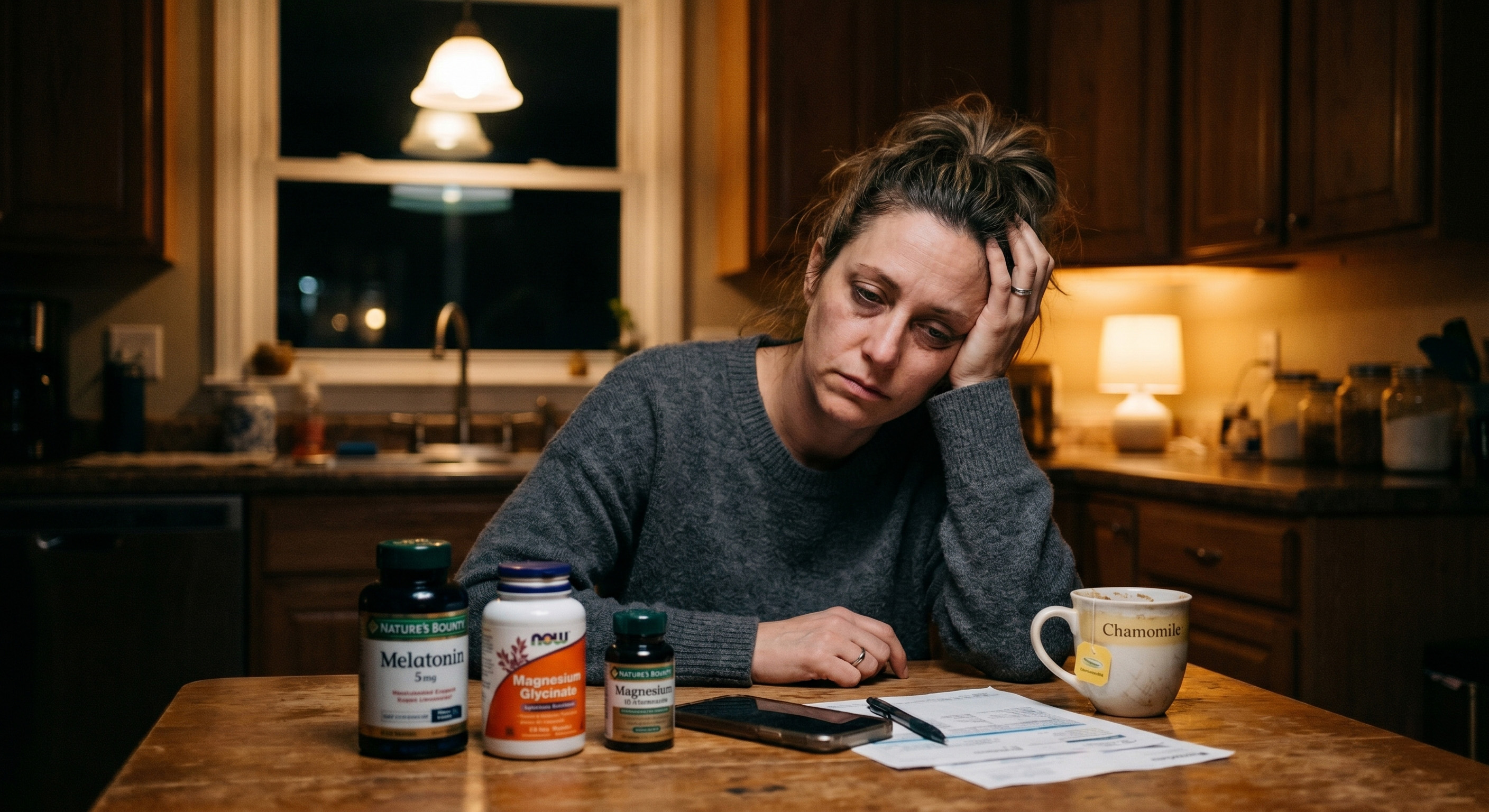
Melatonin, 3 mg. Then 5 mg. Then, on the internet’s advice, 10 mg — which bought her strange, crowded dreams and a morning that felt like wading. The chamomile. The magnesium. The tart cherry juice. A white-noise machine, a weighted blanket, a thermostat pinned at 65 degrees, blackout curtains, no screens after nine, no coffee after noon, a hot shower ninety minutes before bed because a podcast said the temperature drop afterward was the real trick.
Some of it helped a little. None of it held. And there is a particular demoralization in doing everything right and still being awake at 2:58 — because then the only remaining explanation is you.
The sleep lab
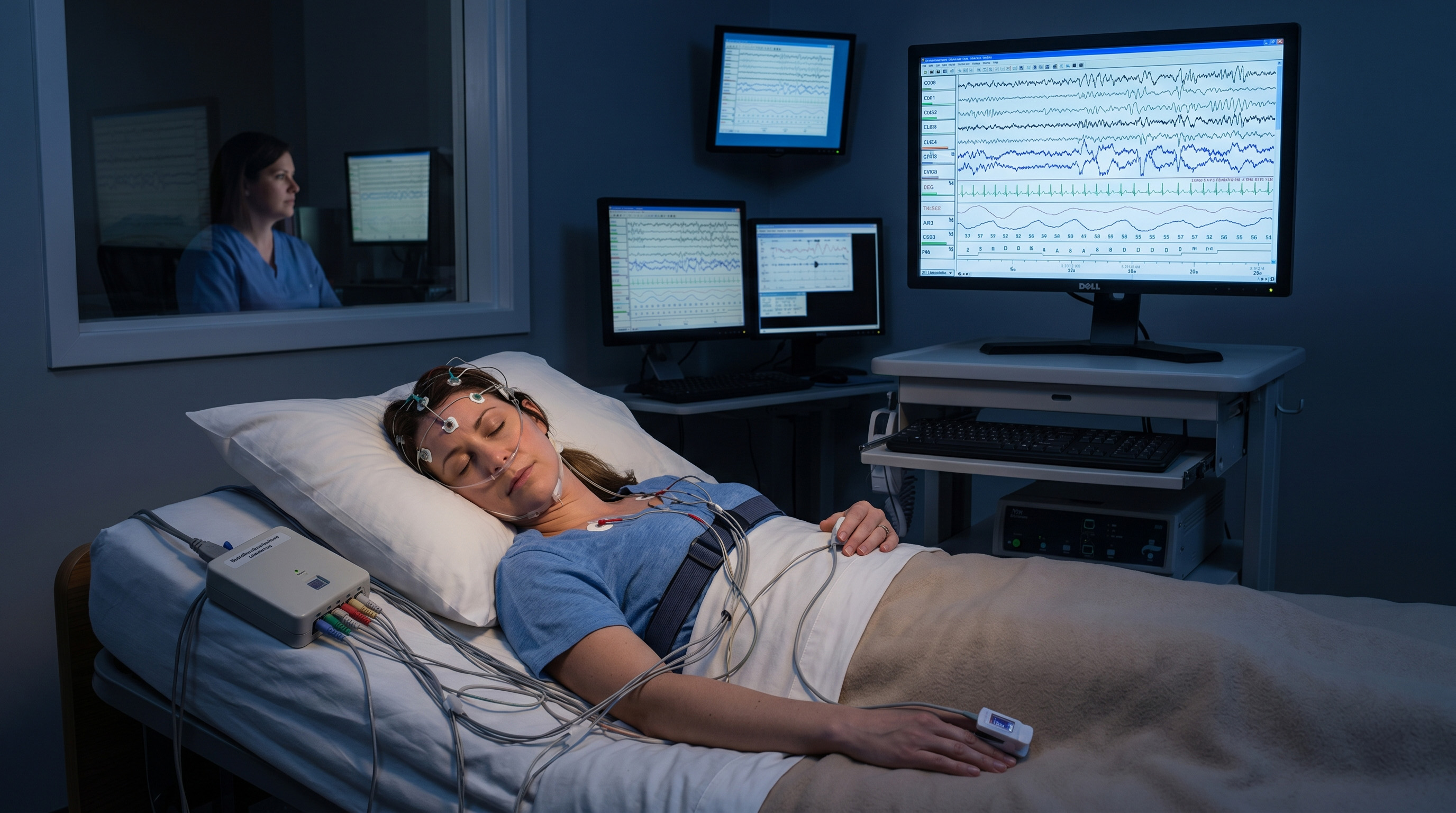
Her family physician referred her out. The wait for a bed at the sleep clinic was fourteen nights; she spent one of them wired to a polysomnograph with electrodes on her scalp, a belt across her chest, a clip on her finger and a technician watching from the next room.
The results ruled out what everyone hopes it is, because apnea has a machine that fixes it. No apnea. No restless legs. No thyroid problem, no anemia, nothing on the panel. What the study did find: 61 percent sleep efficiency, 68 minutes to fall asleep, nine awakenings.
The diagnosis came back as chronic insomnia disorder. The offer that came with it was a prescription sedative-hypnotic.
Whitlock didn’t fill it. Her aunt had spent nine years on one, and Whitlock had watched the arc of that up close: the dose that stopped working, the nights she couldn’t sleep without it, the fog that never fully lifted.
“I didn’t want to be unconscious. I wanted to be asleep. Those are not the same thing.”
Why the pills kept failing her
There is a mechanical reason the spreadsheet had so many failures in it, and it has less to do with the ingredients than with the delivery.
Anything you swallow goes down the same road: stomach, then liver, before it reaches the bloodstream. A meaningful share of the dose is broken down before it ever gets anywhere — the first-pass effect. What survives arrives all at once, spikes, and then falls. That curve is the whole problem for a sleeper like Whitlock. The spike lands around the time she was already managing to fall asleep. The fall lands somewhere near 3 a.m.
“For a lot of people the complaint isn’t sleep onset at all,” says Dr. Peter Halvorsen, a formulation scientist who works on transdermal delivery systems. “It’s the second half of the night. And a single oral dose is almost the worst possible shape for that problem. You get the most active compound at the hour you need it least.”

The second reason is what the pills were mostly made of. Melatonin is a timing signal — it tells the body when night is, which is useful for jet lag and shift rotation and much less useful for a nervous system that already knows perfectly well that it is night and has decided to stand guard anyway. Analyses of over-the-counter melatonin products have repeatedly found actual content varying widely from what the label claims, which does not help.
What Whitlock needed wasn’t a stronger signal. It was the braking system — the calming, inhibitory side of the nervous system that is supposed to take over at the end of the day and, in her case, kept getting overruled.
The envelope from Portland
In March, a padded envelope arrived from Whitlock’s sister Beth, who lives outside Portland and who had heard, by then, a great deal about 2:58. There was no letter in it. There was a sticky note that said: Just try it. Two weeks. Don’t argue with me.
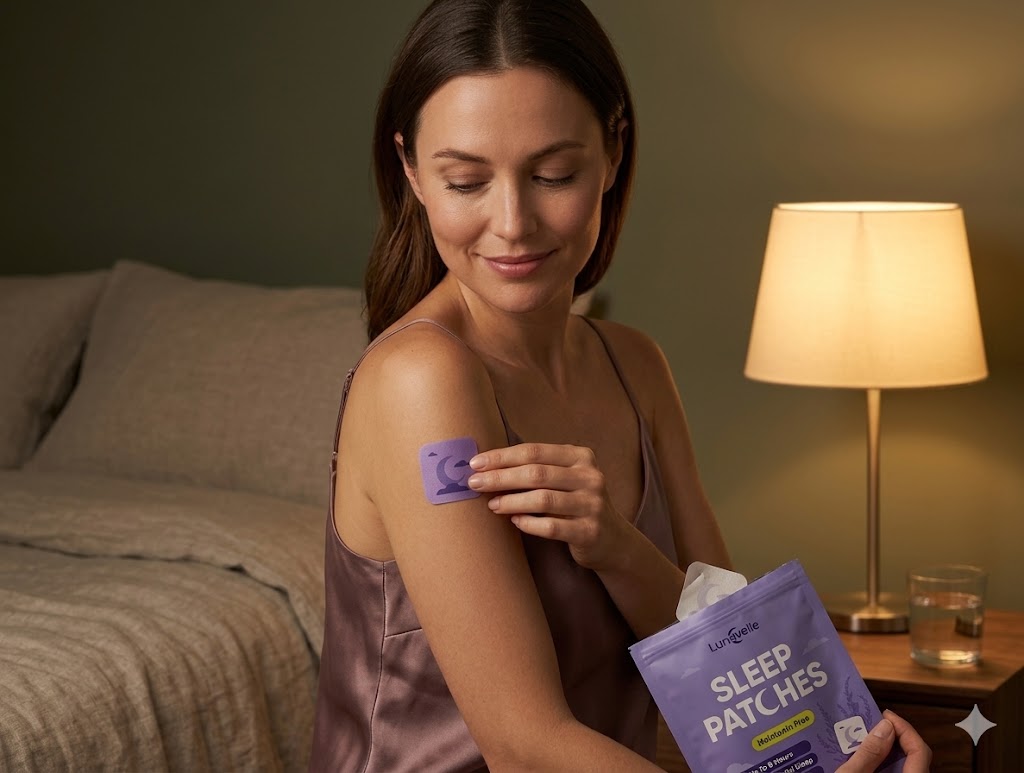
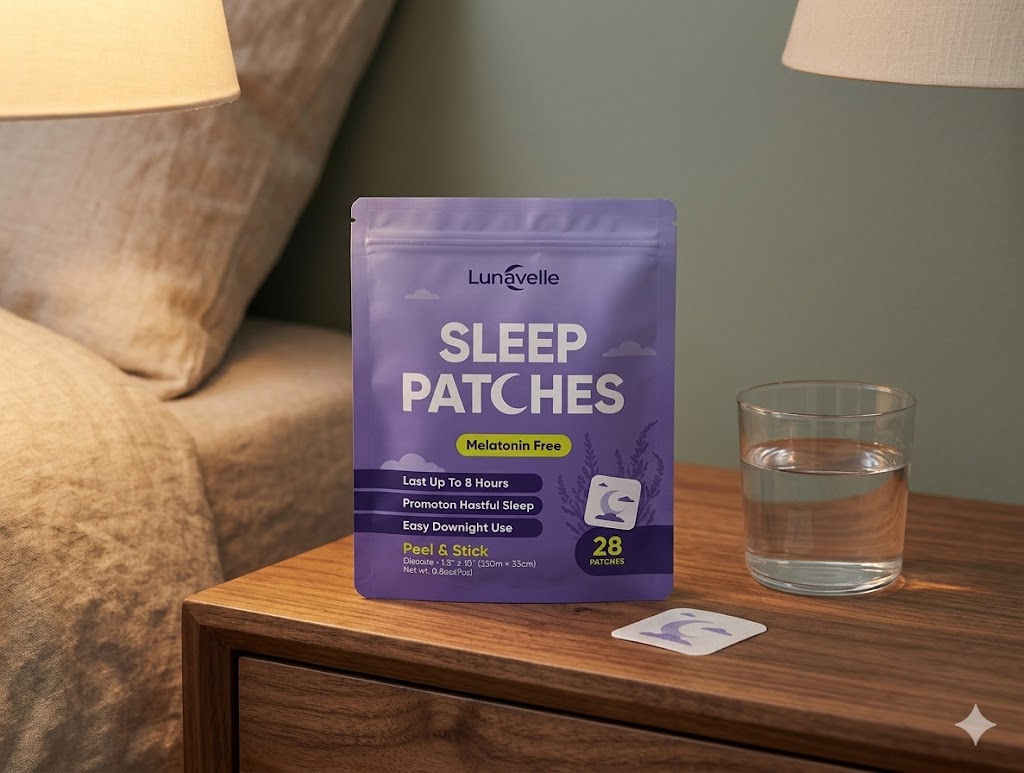
Inside was a lavender pouch of Lunavelle Sleep Patches — 28 thin adhesive squares, about the size of a postage stamp and a half, that you press onto your arm before bed and peel off in the morning.
Whitlock’s first reaction was the correct one, which is to say skeptical. “I’d spent three years and a lot of money on things that didn’t work,” she says. “My honest thought was, great, a sticker.”
She put the pouch in the drawer. Four nights later, at 2:58, she got up and took one out.
What the patch actually is
Lunavelle is not a drug and does not present itself as one. It is a transdermal wellness patch: a blend of six calming botanicals and minerals held in an adhesive matrix that releases them gradually through the skin over roughly eight hours. There is no melatonin in it, no antihistamine, and no prescription sedative compound.
The idea it borrows is old and well established. Transdermal delivery — the same principle behind nicotine patches, motion-sickness patches and hormone patches — has one property that matters enormously for sleep: it skips the stomach and liver entirely, and it releases on a flat curve instead of a spike.
In other words, it is shaped like the problem. Instead of one large dose delivered at 11 p.m. and largely gone by 2 a.m., the patch is still working at the hour Whitlock had spent three years staring at the ceiling.
-
1
Peel
One patch off the backing sheet, about thirty minutes before bed. No water, no measuring, nothing to swallow.
-
2
Press
Onto clean, dry skin — upper arm, shoulder or inner wrist. The adhesive is latex free and dermatologist tested, and holds through sheets and side sleeping.
-
3
Sleep
The blend releases steadily for up to eight hours. In the morning you peel it off and throw it away. There is no dose left over to sleep off.
Six ingredients, and why each one is there
The formula is deliberately short. Everything in it is aimed at the same target Whitlock’s spreadsheet kept missing — the wired, over-alert state — rather than at forcing unconsciousness.
-
Valerian root Traditional calming botanical
The classic wind-down herb, used for centuries for night-time restlessness. It is the backbone of the blend.
-
Passionflower Standardised extract
Long paired with valerian in traditional preparations, aimed at a quieter mind at bedtime rather than a heavier body.
-
Lemon balm Rosmarinic acid
Gentle and faintly citrus. Traditionally used where tension, rather than a lack of tiredness, is what keeps someone up.
-
Ashwagandha KSM-66 extract
An adaptogen for the wired-but-exhausted state — the evening stress load that tends to arrive exactly when you get into bed.
-
L-theanine From green tea
Associated with calm alertness rather than sedation, which is what you want on the way into sleep instead of a blunt instrument.
-
Magnesium glycinate Best-tolerated form
Chosen for gentleness. Delivered through the skin, it also sidesteps the digestive upset oral magnesium is famous for.
Patch versus pill
The comparison below is the clearest way to see why the same intention produces two very different nights.
| Factor | Oral pills & gummies | Lunavelle patch |
|---|---|---|
| Getting into your system | Through the stomach and liver first. A large share never makes it. | Absorbed through the skin, steadily, all night. |
| Release curve | One spike, then a fade well before morning. | Level release for up to 8 hours. |
| The 3 a.m. wake-up | Usually arrives right as the dose wears off. | Still releasing at the hour that matters. |
| Mornings | Grogginess and the sleep-aid hangover are common. | No hard dose to sleep off. |
| The nightly routine | Counting tablets in the dark, water, timing. | Peel, press, done. |
| Melatonin content | Usually the active ingredient, and frequently mislabelled by dose. | None. Zero milligrams. |
What happened at 2:58
Nothing, on night one. Whitlock is emphatic about this, and so is the company: it is not a sedative, and it does not knock anybody out on the first evening.
Night three was the first crack — she remembers getting into bed and not immediately starting the arithmetic. By the end of the first week she was falling asleep faster, though still surfacing in the small hours. The change she actually noticed, she says, was in the mornings: no fog, no wading.
The turn came in week two. On a Tuesday in late March she woke up, looked at the clock, and it said 6:12.
“I sat there and did the math backwards. I’d slept seven hours and twenty minutes. I hadn’t done that since 2022. I cried at my own alarm clock.”
By day 30 the 2:58 wake-ups had gone from nightly to roughly one night in ten, and on the nights they happened she says she got back down in minutes instead of hours. She has been using a patch nightly since, and has skipped nights — a weekend at her sister’s, a forgotten pouch — without the rebound she’d been warned about with prescription sleep medication.

The pattern in the mailbag
Whitlock’s arc — skepticism, a quiet night three, a turn in week two — is close to the modal story in the roughly 12,800 customer reviews the company has collected, which average 4.9 out of 5. A selection, lightly trimmed for length:
-

★★★★★
“I’ve been the 3 a.m. person for eleven years. Week two was when it broke. I still wake up occasionally but I go back down, which never used to happen.”
Dana R. — Columbus, OH
-

★★★★★
“The thing I care about is that I don’t wake up underwater. Melatonin gave me eight hours and a hangover. This gives me seven and a functional morning.”
Michelle T. — Tempe, AZ
-

★★★★★
“Bought it for my wife, ended up ordering a second pouch for myself. The not-swallowing-anything part is underrated when you already take four things at night.”
Greg P. — Naperville, IL
-

★★★★☆
“Honest review: nights one through five, nothing. I almost sent it back. Somewhere around night nine it started. Four stars only because I wish they said that louder.”
Sandra K. — Portland, ME
-

★★★★★
“Travel nurse, rotating shifts. It’s the only thing I’ve used that doesn’t leave me useless if I have to be up in six hours instead of eight.”
Alicia M. — Raleigh, NC
-

★★★★★
“My skin is sensitive and I was worried. Rotating arms solved it. Six months in, no irritation, and it stays on through a hot bedroom.”
Beth A. — Sarasota, FL
What it is not
It is worth being precise, because the category is full of overpromising. Lunavelle is a wellness product, not a treatment for a diagnosed sleep disorder, and it does not claim to be one. It will not fix apnea — nothing you stick on your arm will, and anyone with loud snoring, gasping or heavy daytime sleepiness should be evaluated for it. It is not a sedative and does not behave like one on night one.
Anyone pregnant, nursing, under 18, or taking prescription sleep, anxiety or antidepressant medication should talk to a doctor first, and nobody should stop a prescribed medication on their own. Whitlock, for what it is worth, told hers.
Where things stand
Whitlock still keeps the spreadsheet. There is a row at the bottom of it, started in March 2026 and still open, and the column marked what happened says, in her words, “the thing that worked.”
She has a small ritual now. Patch on at 9:30, book, lamp off around 10:15. Some nights she still wakes up. She looks at the clock and it says something ordinary, like 4:40, and she goes back to sleep, which is the whole and entire point.
“I don’t think about sleeping anymore,” she says. “That’s what I got back. Not the hours — although the hours are nice. I got back not thinking about it.”
Where to get it
Lunavelle Sleep Patches
28 patches per pouch • melatonin free • peel and stick • free U.S. shipping • 60-night money-back guarantee. Sold direct, with no subscription and no auto-shipments.
Because the turning point usually lands in week two, the single pouch is the wrong size for most people. Every option carries the same 60-night guarantee: use it for two months, and if your sleep isn’t noticeably better, you get your money back — opened pouches included.